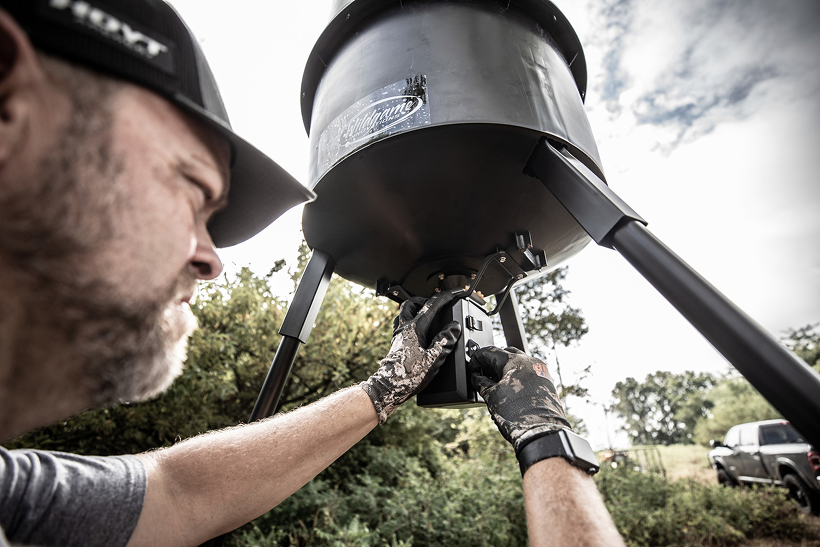
How to Raccoon-Proof a Deer Feeder
A raccoon gets to your corn by climbing a leg and sitting on the spinner. Take away the climb, take away the perch, and take away the standing feed, and you have beaten most of them. Here are the methods that actually work, roughly in the order most hunters stack them.
Slick the Legs So They Can't Climb
The single most effective trick is making the legs impossible to grip:
- PVC sleeves. Slide about two feet of 4-inch PVC pipe over each leg. Leave it loose (chained on or just hanging free) so when a raccoon grabs it, the pipe rolls and dumps him right back on the ground. It is cheap, it is quiet, and it works.
- A Slinky. Stretch a metal Slinky over the leg brackets. When a coon tries to climb, the coils stretch and slide and he goes nowhere. Same principle as the rolling pipe, even cheaper.
- Halos and baffles. A smooth metal "halo" or baffle clamped around each leg gives the raccoon nothing to climb past, the same idea as a squirrel baffle on a bird feeder, scaled up.
Grease the Legs
If you want even simpler, grease works and works well. A coat of axle grease or plain Vaseline on the legs gives a raccoon nothing to hold, and deer are not bothered by it, so it does not cost you visits. The only catch is upkeep: grease wears off and gathers dust, so reapply it periodically, a couple of times a season. The old Crisco-and-cayenne combo is a folk favorite that works for a while too, mixing a slick base with a deterrent.
Cage the Spinner
A few determined raccoons will still find a way up. For them, put a cage or guard around the spinner wheel so they cannot sit on the plate and hand-feed themselves. It does not stop the climb, but it stops the payoff, and a coon that gets nothing eventually quits the site.
Raise It and Time It
Two setup choices quietly do a lot of the work:
- Raise the feeder. Getting the feeder higher off the ground keeps raccoons and squirrels from simply reaching it, and it stacks with slick legs. See how high a deer feeder should be for the numbers.
- Run a timed spin feeder. A spin feeder only throws corn at set times, so there is far less standing feed for a raccoon to camp on than there is under a 24/7 gravity feeder. Less standing food means less reason for a coon to show up at all.
The key point: deny the climb and run a timed feeder. A slick or greased leg plus a high, timed spin feeder beats any single gimmick, and it beats them in combination far better than any one of them alone. Stack two or three of these and the raccoons move on to an easier meal.
Keeping Squirrels and Raccoons Off a Tripod Feeder
Squirrels are the other half of the night-and-day raid, and a tripod's long legs suit both of them. The good news is that the same fixes work on both animals, with one addition:
- Use the same leg defenses. PVC sleeves, baffles and grease stop a squirrel's climb the same way they stop a raccoon's.
- Cut off the jump. Squirrels do not have to climb if they can leap. Set the tripod in the open, away from overhanging limbs and brush they can launch from.
- Cage the spinner. A guard around the plate stops whichever one makes it to the top from sitting there and eating.
- Feed on a timer. Squirrels raid by day and raccoons by night, so a feeder that only drops corn at first and last light gives neither one an all-day buffet.
Deterrents and the Honest Last Resort
Some hunters sprinkle cayenne or hot pepper around the base of the feeder. It is a mild deterrent that works for a while, but it washes off and a hungry raccoon learns to tolerate it, so treat it as a cheap add-on, not a solution.
And the honest truth: no single trick is one hundred percent. Some persistent individual raccoons figure out everything you throw at them, and the only thing that finally ends it is trapping and removal. Before you go to that trouble, it is worth confirming raccoons are actually the culprit, because opossums, squirrels and even bears raid feeders too. A trail camera over the feeder will show you exactly what is hitting it at night, so you fix the right problem. And if your night visitor turns out to be a hog, that is a different fight. See how to keep hogs out of a deer feeder.