Deer Feeder Timer Settings, Explained
There is no single magic setting — feeders vary, and the gap between the hopper and the spin plate changes how much corn each second throws. What follows are honest ranges and starting points, plus how to tune them to your own feeder.
How Long the Spin Should Run
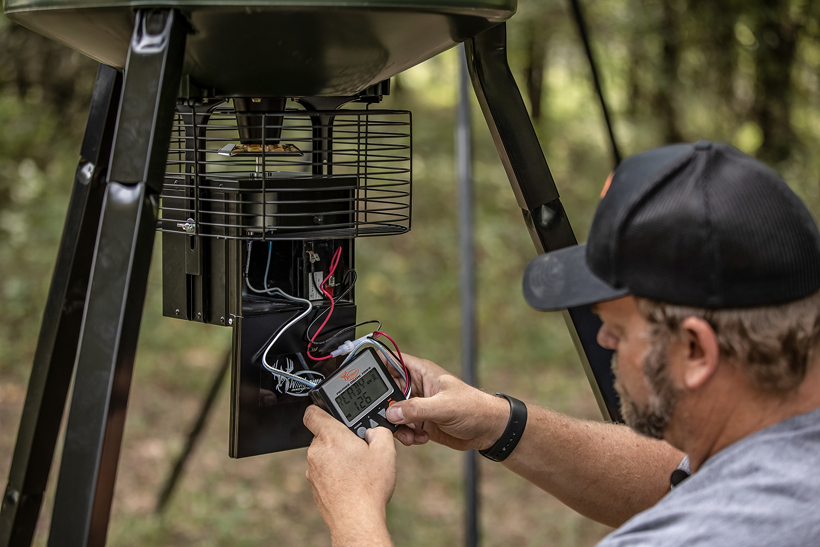
Spin time is the run time per feeding, and it is the setting hunters fuss over most. A short burst of about 2 to 5 seconds throws a nice amount on most units. In the real world, settings range from 3 to 6 or 8 seconds, and some configurations need 8 to 15 seconds depending on the gap between the hopper and the spin plate — a bigger gap drops more feed per second, so the same number means very different amounts on two different feeders.
That is exactly why you should not trust a number off the internet, including ours. Pick a starting point, watch what actually hits the ground, and adjust from there. As a rough estimate, 5 seconds throws about a pound or two of corn on a typical unit — treat that as a ballpark, not a spec, because it varies by feeder.
The one rule that beats every chart: set it to 5 seconds, run one feeding, and read the ground. Too little corn out there? Add a second or two. Burying the plot in corn the squirrels can't finish? Pull it back. Your eyes on your feeder beat any number in any guide.
What Times of Day to Feed
Most hunters run the feeder twice a day: once in the morning around 7:30 to 8:00 a.m., shortly after legal shooting light, and once in the evening around 5:30 to 6:00 p.m., anywhere from 30 minutes to an hour or two before sunset.
The reason for those windows is the whole point in season: feed during legal light so deer learn to associate the sound of the spin with daylight and show up while you can actually see — and hunt — them. A feeder that goes off in the dark just trains deer to move at night.
- In season: bias both feedings to legal light. Morning a little after first light, evening before the sun is down.
- Off season: you can add a midday feeding to inventory bucks on a trail camera — there is no shooting light to protect, so you just want them on camera.
Those windows are the baseline, and you can sharpen them. Check today's deer feeding times for your zip code and nudge the evening drop so it lands just ahead of a major feeding period in shooting light.
How Many Feedings Per Day
One to two feedings a day is typical, and twice is the standard for hunting season. More feedings is not automatically better: every extra drop drains the hopper faster and invites more pressure from non-target critters — raccoons, hogs, squirrels, and birds all key on a feed site that runs all day. Fewer, well-timed feedings keep the corn for the deer and stretch the bag.
If pests are already a problem, the timer is only half the fix. See keeping raccoons out and the right feeder height for the rest.
A Starting Point You Can Tune From
Here is a sensible place to begin. Set this, watch a feeding or two, then nudge the spin time to match what your feeder actually throws.
| Goal |
Spin time |
Feedings / day |
| Just starting out |
5 seconds |
2 (morning + evening) |
| Conserve corn |
3 to 4 seconds |
1 to 2 |
| Hold more deer |
6 to 8 seconds |
2 |
| Big gap under plate |
8 to 15 seconds |
1 to 2 |
| Off-season inventory |
5 seconds |
2 to 3 (add midday) |
These are starting points, not gospel. The big-gap row is the reminder that your hardware, not the clock, decides how much lands per second.
How Long a Bag of Corn Lasts
Once you know your spin time and number of feedings, this is just arithmetic. Estimate how much each spin throws, multiply by feedings, and divide your bag into it:
- Estimate per spin. Call it about 1.5 lb at a 5-second spin on a typical unit — confirm by eye at your own setting.
- Multiply by feedings. Two feedings a day at ~1.5 lb each is roughly 3 lb per day.
- Divide the bag. A 50 lb bag at ~3 lb a day lasts about two weeks.
Run a longer spin or a third feeding and that bag empties faster; trim to one short feeding and it stretches well past two weeks. The point is that you can predict refill trips instead of guessing — and a trail camera on the site tells you whether the timing is actually pulling deer in during daylight, which is the only feedback that matters.
Programmed but Not Throwing?
If the timer is set correctly and the feeder still will not sling corn, the settings are not your problem — the hardware is. The number-one culprit is the battery: a 12V motor will hum but not turn a loaded plate on a battery that has sagged to 6V or lost its amperage. Test or swap it first, then check for a jammed plate or a loose set-screw. The full checklist is in why your deer feeder is not spinning.