A weatherproof camera, a motion sensor and a lot of patience. Here is what happens between a deer stepping into frame and the photo landing on your card or your phone.
How Do Game Cameras Work? The Short Answer
A trail camera, also called a game camera or deer camera, is a weatherproof camera that takes pictures on its own. A motion sensor watches for the heat of a moving animal, the camera wakes and fires, and the photo is saved to a card or sent to your phone. You strap it to a tree, walk away, and it watches the spot for weeks while you are somewhere else.
This page covers how that works. Each guide further down answers one question in more depth.
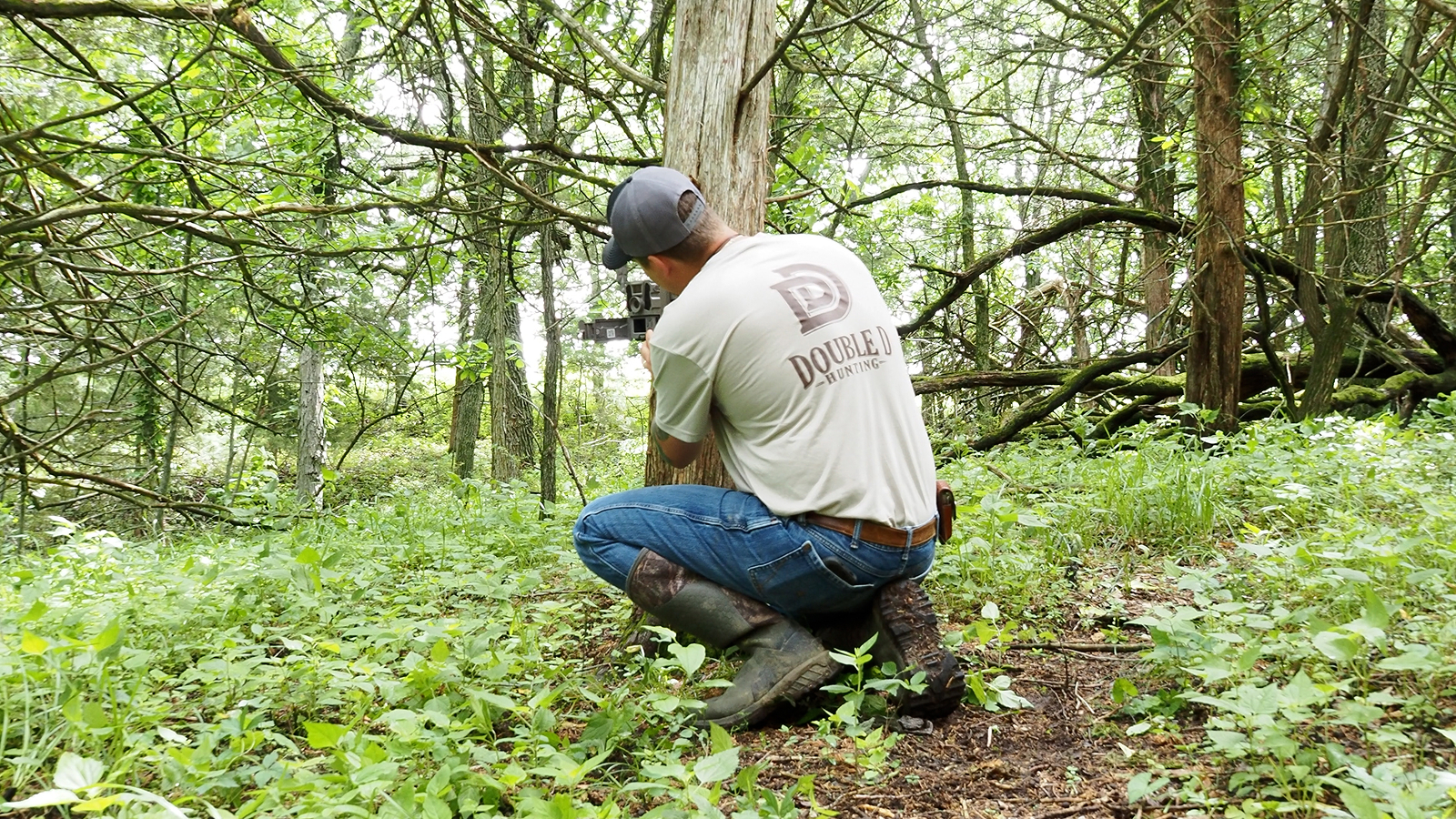
Hanging a trail camera at waist height on the trunk, on a real Double D scouting setup in mid-summer.
How a Trail Camera Works
What Is a Trail Camera?
A trail camera is a self-contained, battery-powered camera built to live outdoors and fire automatically when something moves in front of it, day or night. Every image carries the date, time and usually the temperature. Hunters use them to scout: to learn which deer use an area, when they move and which trails they favor, without leaving scent on the spot every day. The same camera watches a driveway or a back gate just as well.
Are Trail Cameras Motion Activated?
Yes. The heart of every trail camera is a passive infrared (PIR) sensor, the same technology as a motion-sensing porch light. It sends nothing out. It reads the infrared heat in front of it and looks for a warm object moving against a cooler background. A deer crossing a field at dawn is a moving patch of body heat, and that trips the sensor.
It is also why you get the occasional empty photo. A sun-warmed branch swaying in the wind can look like "warm and moving" to the sensor. Those false triggers are mostly a placement problem, covered in where to place a trail camera.
A warm animal moving through the detection zone trips the PIR sensor, and the camera captures and stores the shot.
Trigger Speed (Shot Lag), Detection Range and Recovery Time
Three numbers decide whether you actually get the photo:
Trigger speed, also called shot lag, is the delay between the sensor detecting movement and the shutter firing. A fast trigger, like the 0.2 seconds Spypoint lists for the Force-Pro, catches a walking deer mid-frame. A slow one catches its back half leaving.
Detection range is how far out the sensor picks up an animal. Flash range is how far the flash lights it at night. Keep the two roughly matched so the camera is not detecting deer it cannot light.
Recovery time is how long the camera needs before it can fire again. A short one catches the second and third deer in a group instead of just the first.
How Trail Cameras Take Pictures at Night
At night the camera supplies its own light in one of three ways. White flash gives full-color photos but is obvious to deer and people. Low-glow infrared gives black-and-white photos and shows a faint red glow when it fires. No-glow infrared shows no visible glow, at the cost of a little range. Which one deer notice is covered in can deer see trail camera flash.
Cellular vs. Standard (SD) Trail Cameras
How the photo reaches you is the other big split:
Standard (SD)
Cellular
How you get photos
Pull the SD card and view it on a phone or computer
Sent to a phone app over the cell network
Monthly cost
None
A data plan, set by the brand
Best for
Spots you walk past anyway; lowest running cost
Spots you do not want to disturb
The case for cellular is less intrusion: every walk in to swap a card leaves scent and pressure. The full breakdown, including how cellular differs from wifi cameras, is in how cellular trail cameras work. If you would rather skip the plan, see non cellular trail cameras.
Whichever you pick, power is what keeps it running: lithium AAs outlast alkalines, especially in the cold, and a solar panel can keep a camera out for months. The battery and solar guide has the detail.
Go Deeper: Trail Camera Guides
Pick the question you came here to answer. Each guide is a focused, no-fluff breakdown of one topic.
A passive infrared (PIR) sensor watches the area in front of the lens for the heat and movement of a passing animal. When it detects one, the camera wakes, takes a photo or video stamped with the date and time, saves it to an SD card or sends it to your phone over a cellular network, then goes back to sleep until the next trigger.
What Is the Difference Between a Trail Camera and a Game Camera?
None. Trail camera, game camera, deer camera and scouting camera all mean the same thing: a weatherproof, motion-triggered camera you mount to a tree to watch wildlife or property while you are away.
What Is Shot Lag on a Trail Camera?
Shot lag is another name for trigger speed: the delay between the sensor detecting an animal and the camera taking the picture. Shorter is better. A camera with a fraction-of-a-second shot lag catches a walking deer in the middle of the frame instead of its tail leaving.
Are Trail Cameras Motion Activated?
Yes. A passive infrared sensor triggers the camera when a warm object moves in front of it, so it fires on its own, day or night. Many cameras also offer a time-lapse mode that takes pictures on a schedule instead.